








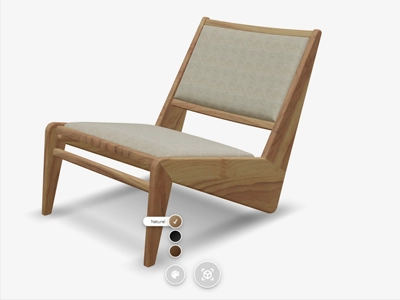



Speed and quality
A Fast 3D Product Configurator in Photo Quality
Vulp’s 3D configurator and 3D viewer are on screen almost immediately and respond the moment you turn the product, in your own webshop too. We do not just say so: we measure the load time with real visitors, across every viewer that is live. Try it yourself with this moped.
Live demo
Measured with real visitors
How fast the viewer appears
Measured with real visitors, across every viewer that is live.
0.34 s
Half of all views have the viewer on screen within this time
0.49 s
On desktop, in 3 out of 4 views
0.71 s
On a laptop, in 3 out of 4 views
4.22 s
On mobile, in 3 out of 4 views
On a tablet: 1.40 s (p75). Turning and clicking respond within 72 ms (p75). The page barely jumps. Measured with Umami, 25 to 27 August 2026.
Under the hood
Why our 3D configurator loads this fast
Whether you put a 3D product viewer or a complete 3D product configurator in your webshop, both run on the same viewer, and so at the same speed.
Light, compressed models
We aim for 3D models under 1 MB, with a maximum of 5 MB. Every model travels compressed, so it arrives quickly without giving up any detail.
Smooth to turn
Turning, zooming and clicking respond immediately, without stutter.
In any browser, no app
The viewer runs straight in the browser on desktop, tablet and phone. Nothing to install, nothing to wait for.

Works on every screen
The viewer adapts to any screen, from a large monitor to a phone. On desktop and laptop it appears almost immediately, and on a tablet or phone you simply turn and zoom with your fingers.
- turn, zoom and choose with a mouse, touchpad or fingers
- on a phone, place the product in your own room with augmented reality
- one embed code for any website or webshop

Photorealistic 3D models, built to animation-studio standards
Most configurator platforms are software companies. We make the 3D models ourselves, and they have to meet the standards of an animation studio. So the model and the viewer come from one team.
Our standard: a virtual product has to look as good as a professional product photo. Texture, reflection and seams have to be right, even when you zoom in. From the same model, the Content Creator makes packshots and product videos that can stand next to a photo shoot.
Fast without quality is an empty viewer. Quality without speed is a viewer nobody waits for. That is why we look at both for every model.

Research
Why every tenth of a second of load time counts
+8.4% conversions
for retailers, when their mobile site got 0.1 seconds faster

+9.2% order value
per order on average, for those same retailers

+10.1% conversions
in travel, for the same 0.1 seconds
Source: Deloitte and 55, Milliseconds Make Millions (2020), commissioned by Google: 37 European and American brand websites and more than 30 million sessions. The study is about web pages in general, not about 3D viewers specifically. More research is on our page about 3D and AR in e-commerce.
How we measure load time
- What: the Largest Contentful Paint, the moment the largest element on the page is on screen. In the Vulp viewer, that is the loading screen. We will soon measure the time until the model can be turned separately
- Response and stability: Interaction to Next Paint (how fast the view responds to turning and clicking) and Cumulative Layout Shift (how much the view jumps). Together with the Largest Contentful Paint, these are Google’s three Core Web Vitals
- Where: every Vulp viewer that is live, both embedded on customers’ websites and opened directly
- How: with Umami, an analytics tool we host ourselves. Umami sets no cookies and stores no data by which a visitor can be directly identified
- Which number: the 75th percentile, as Google uses. In 3 out of 4 views, the result is better than that number
Caveats to the measurement
- Some views come from the browser’s cache, for example when someone looks at the same product again. Those views are faster than a first visit. We are going to measure first and returning views separately
- Views in a tab that loads in the background are counted. They make the slow end of the numbers slower than what a visitor really experiences
- The measurement is sent after 10 seconds. A view that takes even longer is counted with the value at that moment
Test a fast 3D configurator with your own product
The strongest test is your own product on your own website. We build a free demo with one of your products, so you can see for yourself how fast it is and how good it looks.
Frequently asked questions
Will a 3D configurator slow down my webshop?
Your page does not have to wait for it. The Vulp viewer loads in its own iframe, with files from our own servers, so your webshop keeps building while the 3D model comes in. If the configurator sits further down the page, loading="lazy" makes it load only when the visitor scrolls to it.
How fast does the Vulp 3D configurator load?
On desktop the viewer is on screen almost immediately, and turning, zooming and clicking respond at once. We measure it with real visitors, across every viewer that is live. The current numbers per device and how we measure them are on our page about speed and quality.
Does the 3D configurator work on mobile too?
Yes, in any mobile browser, with no app. On a phone, load time depends more on the connection than on desktop. That is why every 3D model is delivered compressed, and why we are working to make the viewer faster still on mobile.
Does a fast 3D configurator cost quality?
Not with us. We make the 3D models ourselves and keep them as light as possible, without a difference you can see: we aim for under 1 MB per model, with a maximum of 5 MB. Texture, reflection and seams have to look as good as in a professional product photo.