








3D and AR in E-commerce: What the Research Actually Shows
Interactive 3D and augmented reality are not a gamble. Independent industry and academic research shows what they do to conversion, engagement and buying confidence.
Here are the numbers, the sources behind them, and what Vulp does with each one.
94% higher conversion for products with 3D or AR content
Source: Shopify, platform data across merchants using 3D and AR product media.
Products that let shoppers interact in 3D or AR converted 94% better than products without. It is the most quoted figure in e-commerce for a reason: it comes from an enormous merchant base, across categories, in real stores rather than a lab.
Why Vulp is built for this
Getting that content onto your product page is one line of code. The viewer embeds in any webshop or website, WooCommerce, Shopify, Magento or your own build, and we host the 3D files so your page speed stays yours.
From the same model, our Content Creator generates packshots, AI lifestyle images and product video. One 3D asset upgrades your entire product page, not just one widget on it.
Figure published by Shopify from its own platform data.
74% of consumers expect AR to become more important
Source: Deloitte Digital and Snap Inc., Snap Consumer AR: Global Report (2021). Survey of 15,000 consumers across 15 countries, plus more than 50 interviews with AR specialists.
Over 100 million people were already shopping with AR when that research was published, and shopping was one of the four areas where consumers most expected their AR use to grow. The expectation is already in your customers’ heads. The question is whether your product page meets it.
Why Vulp is built for this

Vulp’s AR runs in the browser on both iOS and Android. No app to download, no store listing, no development project. Customers place your product in their own room at true-to-life scale, on the floor or against the wall, straight from the product page.
For visitors on desktop there is a scannable QR code with your own message, so the AR experience moves to their phone without losing them.
Research conducted by Deloitte Digital, commissioned by Snap Inc., 2021. Download the full report (PDF).
360-degree images beat flat photos
Source: Kim, S., Baek, T. H., & Yoon, S. (2020). The effect of 360-degree rotatable product images on purchase intention. Journal of Retailing and Consumer Services, 55, 102062. doi.org/10.1016/j.jretconser.2020.102062
Across three experiments, shoppers who could rotate a product reported significantly stronger purchase intention than shoppers shown a static image of the same product. The mechanism is sensory vividness: turning a product makes it feel tangible, and that feeling drives the decision to buy.
The same research found the effect is strongest when the interaction is immediate. A rotatable view that a shopper has to hunt for does not do the work.
Why Vulp is built for this
The Vulp viewer sits inline on your product page and is interactive the moment it loads. No lightbox, no extra click, no “view in 3D” button to find first.
Because every angle is rendered from one 3D model, the lighting, shadows and materials stay consistent all the way around, which photo sets rarely manage. Add auto-rotate and the product is already turning when the shopper arrives.
Three experiments published in the Journal of Retailing and Consumer Services, 2020.
What actually drives the intention to buy
Source: Guo, C., & Zhang, X. (2024). The impact of AR online shopping experience on customer purchase intention: An empirical study based on the TAM model. PLOS ONE, 19(8), e0309468. doi.org/10.1371/journal.pone.0309468
This study separated how useful a 3D and AR experience feels from how easy it is to operate, and tested both against purchase intention. Usefulness was by far the stronger driver.
Beautiful and useful are not opposites here. A photorealistic product earns attention and builds trust; being able to check dimensions, switch materials and compare variants is what turns that attention into an order. You need both.
Why Vulp is built for this
We come from high-end 3D animation, and it shows in the models. Realistic materials, shadow and lighting mean your product looks on screen the way it looks in real life.
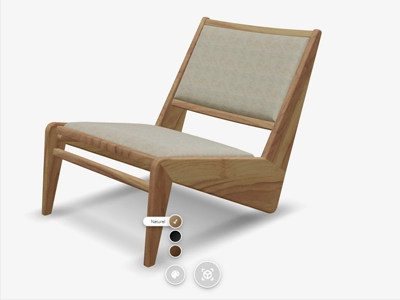
That same viewer then helps people choose. Information hotspots explain features at the point the customer is looking at them. Measurement layers show dimensions and specifications, so nobody guesses whether it fits. Colours and materials switch live, including full colour systems such as RAL. Product variations let customers build the exact configuration they will receive, and if you would rather drive all of that from your own interface, the API exposes the same controls.
Every feature we build becomes available to all our customers, rather than being commissioned for one client. That is how you get the level of a bespoke project at a fair price, without an enterprise budget.
Survey of 202 AR shoppers measuring stated purchase intention, PLOS ONE, 2024.
Every variant, without the sample stock
Photography scales badly against choice. A sofa in twelve fabrics and four leg finishes is 48 shoots, and every new fabric next season means booking the studio again. Most brands solve that by photographing the bestsellers only, which quietly tells customers that the rest of the range is not really available.
A 3D model does not have that problem. Once the product exists digitally, every combination exists with it, and adding a colour costs a setting rather than a shoot.
Why Vulp is built for this
Every colour and material is there the moment the model is. No sample stock to build, store and photograph for variants you may never sell, and no limit to showing only the finishes that happen to be on the shelf.
Our Content Creator renders packshots and AI lifestyle images from the same model that powers your interactive viewer, so your catalogue images and your product page always show the identical product.
Lighting, shadow, camera angle and materials are defined once and applied to everything. Your whole range stays consistent in colour and styling, which a shoot spread across months and seasons rarely manages.
Fewer surprises, so fewer returns
A return almost always starts the same way: what arrives is not quite what the customer pictured. The colour is off, the size does not work in the room, or the material looks different from the photo.
Remove that mismatch and you remove the reason to send it back. A customer who has turned the product around, checked its dimensions and seen it at full scale in their own room knows what is arriving. Expectations set before the order are expectations met after it.
A return that never happens saves more than the sale: no shipping both ways, no handling in your warehouse, and no product you can no longer sell as new.
Why Vulp is built for this
Vulp shows the exact variant your customer configured: their colour, their material, their size, at true scale in their own space through AR. What they approved on screen is what ships.
Because all of your imagery comes from the same 3D model, the colour in the configurator is the colour on your product page and in your catalogue images. No gap between the photo and the product, so nothing to be disappointed about when the box opens.
See it on your own product
The strongest evidence is your own. We build a free demo with one of your products so you can judge the effect on your own product page, with your own customers.